Written by Phillip George · Last updated: August 30, 2026
Beginner questions cover the four species most people actually meet and the basics of removal and rash. Field questions are the ones that change what you do: which species carries which pathogen, what the prophylaxis window is, when adults are active. Expert questions come from 2026 surveillance reports and peer-reviewed papers and are genuinely hard. Your tier choice is stored in the page address, so you can copy the URL and send someone the same set.
-
This adult female has a single pale spot in the middle of her back. Which species is she?
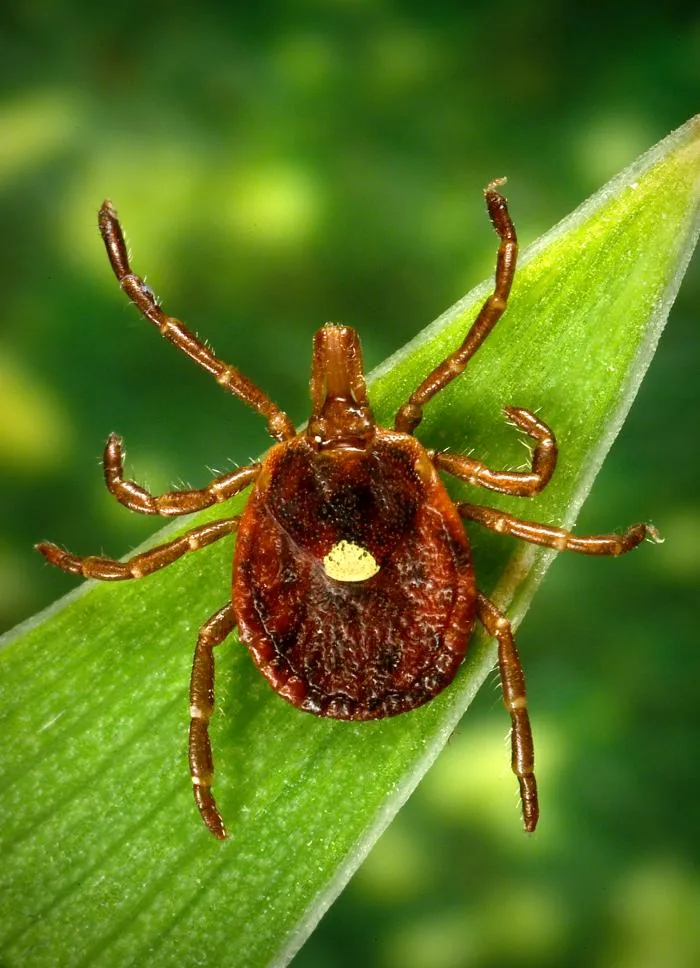
Public domain image, CDC Public Health Image Library. Answer and explanation
B — Lone star tick. CDC describes the adult female as distinguished by a white dot, or "lone star", on her back. It is a very aggressive human biter, widely distributed across the Northeast, South and Midwest of the United States. Nymphs and adult females most frequently bite people.
One caution the picture cannot show you: males lack the dot and have faint pale streaks near the edge of the body instead, and lone star ticks do not always show a clear spot at every stage.
Source: CDC — Where Ticks Live
-
A large tick with whitish, marbled markings across its shield, found on a dog in Ohio. Which species is most likely?
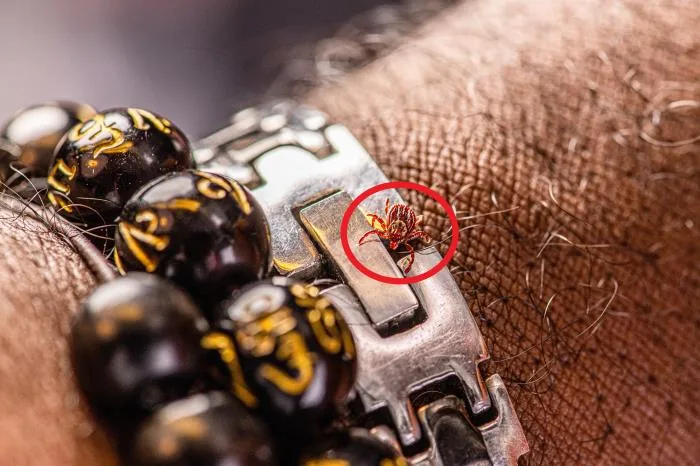
Public domain image, CDC Public Health Image Library. Answer and explanation
C — American dog tick. The ornate pale marbling is the Dermacentor signature, and in Ohio the Dermacentor you meet is D. variabilis, which CDC describes as widely distributed east of the Rocky Mountains. It transmits tularemia and Rocky Mountain spotted fever; adult females are the stage most likely to bite humans, and the highest risk is spring and summer.
Answer B is the trap, and it is a fair one. The Rocky Mountain wood tick (D. andersoni) looks very similar. What separates them here is geography, not markings — see Q17.
Source: CDC — Where Ticks Live
-
Which tick transmits the bacteria that cause Lyme disease in the eastern United States and eastern Canada?
Answer and explanation
B — Blacklegged tick. CDC lists Borrelia burgdorferi and B. mayonii, the bacteria that cause Lyme disease, among the pathogens I. scapularis transmits. The American dog tick transmits tularemia and Rocky Mountain spotted fever, not Lyme. The lone star tick transmits Bourbon virus, Ehrlichia species, Heartland virus and tularemia.
Option D is the most common and most consequential misconception on this page. Species matters more than attachment time: a wood tick attached for a week cannot give you Lyme disease, because it does not carry the bacterium.
Source: CDC — Where Ticks Live
-
Looking at these blacklegged tick life stages: which stages are most likely to bite a person?
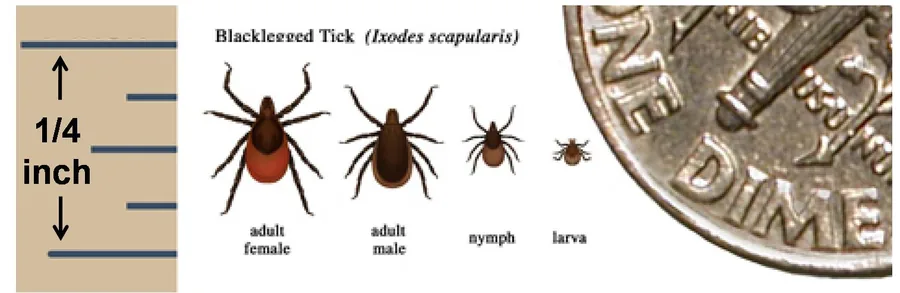
Blacklegged tick (Ixodes scapularis) life stages compared. Answer and explanation
C — Nymphs and adult females. CDC states plainly that for I. scapularis the "stages most likely to bite humans are nymphs and adult females", and says the same of the western blacklegged tick, I. pacificus. Larvae do bite people, but less often.
This is why nymphs dominate Lyme disease risk despite being the harder stage to notice: they bite readily and they are tiny.
Sources: CDC — Where Ticks Live · CDC — Blacklegged Tick Surveillance
-
You find an attached tick. Which method does CDC actually recommend?

Fine-tipped forceps. A plain set of tweezers works too. Answer and explanation
B. CDC's instruction is to grasp the tick as close to the skin's surface as possible with clean fine-tipped tweezers and pull away from the skin with steady, even pressure — no twisting, no jerking, because that can break the mouthparts off in the skin. If mouthparts do break off and will not come out easily with tweezers, leave them alone; the skin pushes them out as it heals. Clean the bite and your hands afterwards, and never crush the tick with your fingers.
Option D is wrong for a specific reason CDC spells out: delaying removal to get help from a provider can increase your risk of infection. Remove it now.
Source: CDC — What to Do After a Tick Bite. Step-by-step on our tick removal guide.
-
This blacklegged tick looks nothing like the flat, sesame-seed shape in the reference photos. Why?
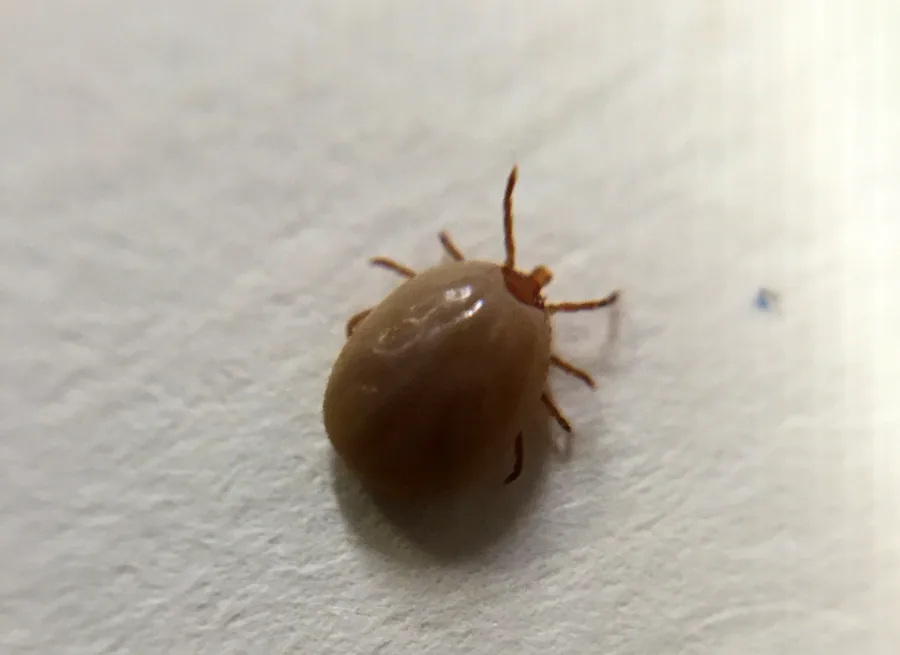
The same species you saw in Q4, after feeding. Answer and explanation
C — it has fed. A blood meal stretches the body several times over and washes out the colour and pattern, which is exactly why identification services ask for the clearest possible photograph and why an engorged specimen is harder to key out than an unfed one. Note that the small dark shield behind the head does not stretch, which is one of the few landmarks that survives feeding.
Practical consequence: if you are going to photograph a tick, do it before it feeds if you possibly can, and photograph the back.
Sources: eTick.ca photo submission guidance · our identification guide
-
Ten days after removing a tick you notice an expanding red patch spreading outward from the bite. What does CDC advise?
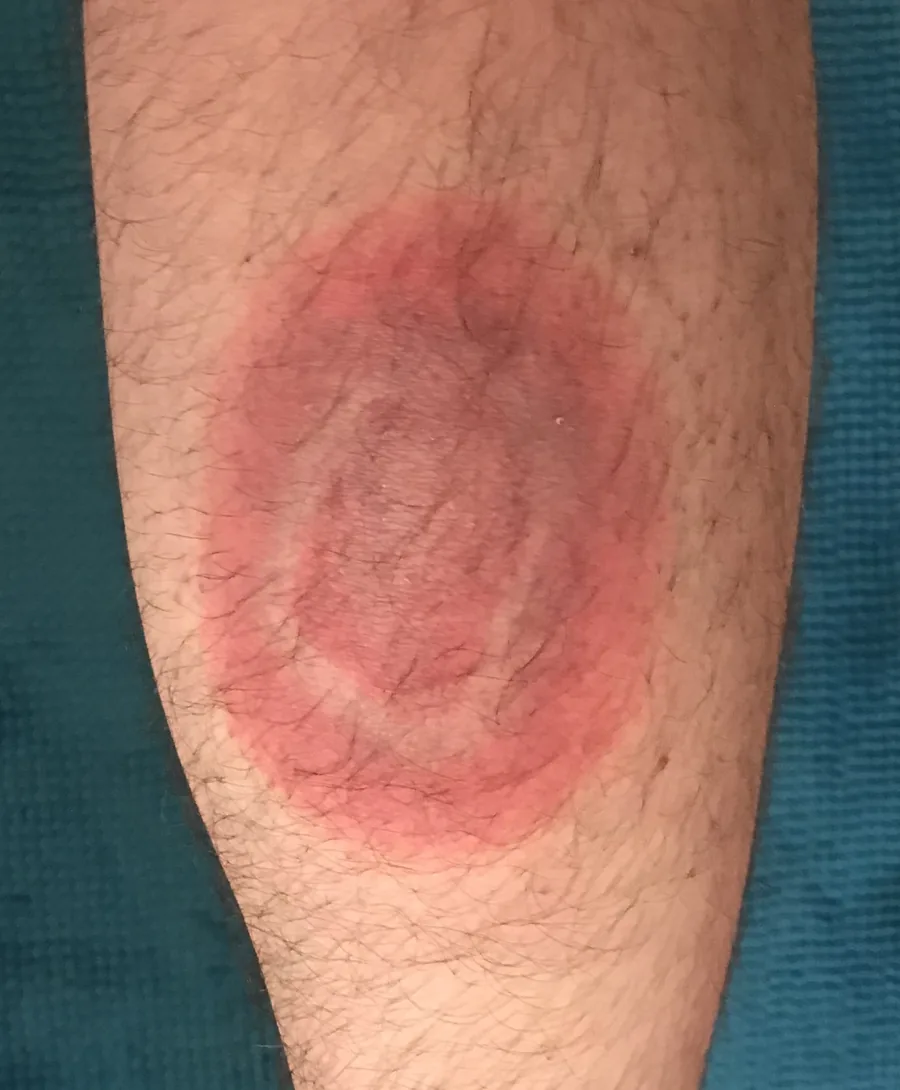
An expanding rash of this kind is called erythema migrans. Answer and explanation
B — see a provider. CDC's guidance is direct: if you develop a rash or a fever within several days to weeks of removing a tick, see your doctor. An expanding rash of this kind is called erythema migrans, and the investigators in CDC's 2026 western North Carolina study counted documented erythema migrans after a tick exposure as evidence of infection.
Worth separating from this: a small area of redness and discomfort right at a lone star tick bite can be caused by the tick's saliva and does not by itself indicate infection, per CDC. An expanding rash days later is a different signal.
Sources: CDC — What to Do After a Tick Bite · MMWR 2026;75(31)
-
Which set of measures does CDC recommend for preventing tick bites?
Answer and explanation
D. This is the list CDC's own investigators reproduced in the 2026 North Carolina report: appropriate protective clothing, Environmental Protection Agency–registered insect repellents, and checking the body for ticks after spending time outdoors. North Carolina's public health guidance adds showering soon after coming indoors, permethrin-treated clothing, and creating tick-safe zones in the yard.
Option C is not merely useless, it is contrary to guidance — antibiotic prophylaxis is a narrow, criteria-based decision after a specific qualifying bite, not something taken pre-emptively. See Q14.
Sources: MMWR 2026;75(31) · NC DPH clinician memo (PDF). More on our prevention tips page.
-
A blacklegged tick shown on a coin for scale. What is the practical lesson?
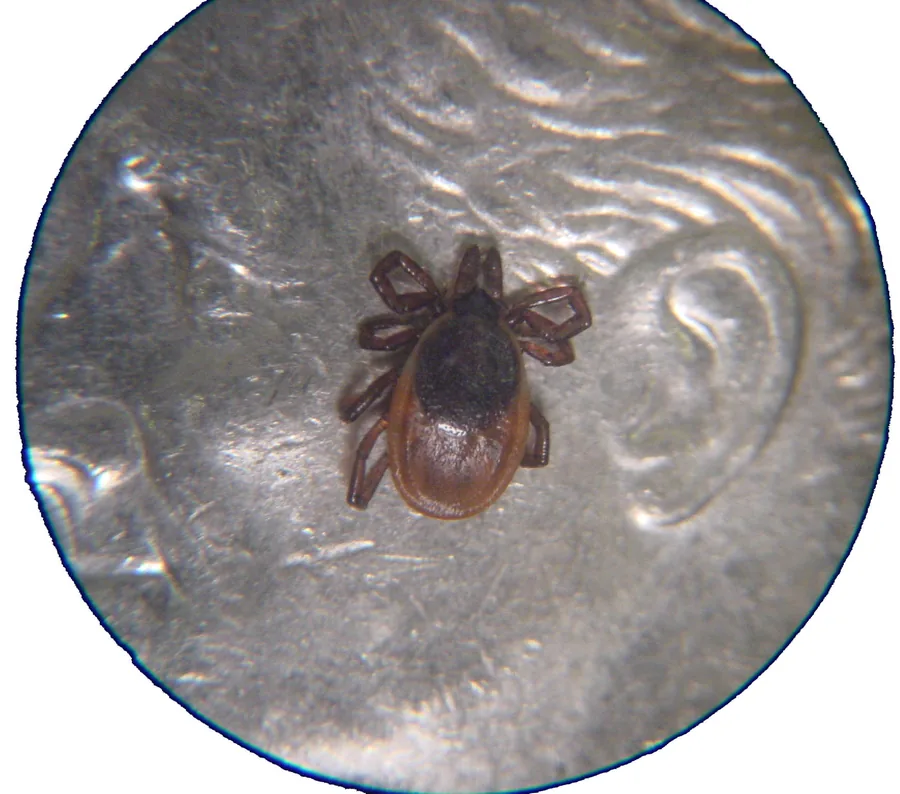
Scale comparison against a US dime, which is 17.9 mm across. Answer and explanation
B. Nymphs are among the stages most likely to bite people, and they are small enough to pass for a freckle or a speck of dirt. That combination is why CDC's advice is an actual check of the body after time outdoors rather than a casual look, and why showering soon after coming inside helps — it dislodges ticks that have not yet attached.
Option C fails on CDC's own statement that nymphs and adult females are the stages most often reported biting humans. Small does not mean harmless.
Sources: CDC — Where Ticks Live · CDC — What to Do After a Tick Bite
-
Uniform reddish-brown, no ornamentation, elongated body. Dogs are its primary host at every life stage. Which species?
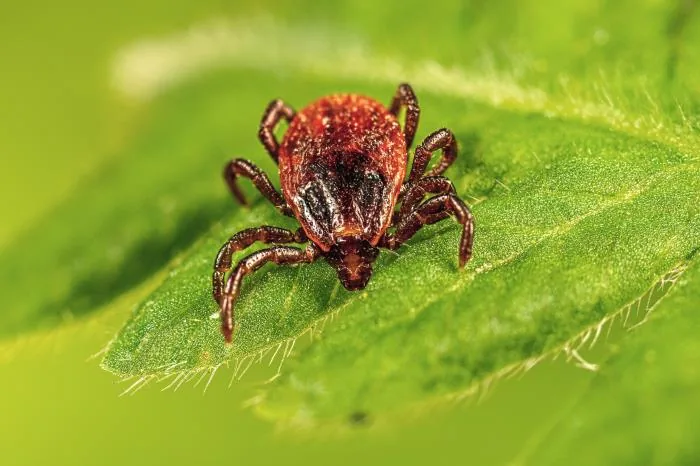
Public domain image, CDC Public Health Image Library. Answer and explanation
B — Brown dog tick. CDC records its distribution as worldwide, notes that dogs are the primary host in each of its life stages, and lists it as transmitting Rocky Mountain spotted fever in the southwestern United States and along the US–Mexico border. It may also bite humans and other mammals. It is also the one tick in CDC's North American list that occurs in Hawaii.
The name confusion is worth untangling: "brown dog tick" and "American dog tick" are different species with different ranges and different disease profiles, and neither is the "wood tick" of prairie usage.
Source: CDC — Where Ticks Live. See also our pets and ticks guide.
-
Which of these does the lone star tick not transmit, according to CDC?
Answer and explanation
C — Borrelia burgdorferi. CDC's list for Amblyomma americanum is Bourbon virus, Ehrlichia chaffeensis and E. ewingii (human ehrlichiosis), Heartland virus, and tularemia. The Lyme disease bacterium is not on it.
The reason this trips people up: a circular rash of unknown cause, called STARI, sometimes follows a lone star tick bite and looks like the rash of early Lyme disease. CDC also notes growing evidence that alpha-gal syndrome may be triggered by lone star bites.
Source: CDC — Where Ticks Live
-
A patient develops hives and stomach pain several hours after eating beef, having been bitten by ticks repeatedly over the summer. Which tick is most often associated with this in the United States?
Answer and explanation
A — Lone star tick. This describes alpha-gal syndrome, an allergy to a sugar molecule found in most mammals that can develop after a tick bite. CDC states that in the United States AGS is primarily associated with the bite of a lone star tick, with a few cases reported after blacklegged and western blacklegged tick bites.
Two details that matter clinically: not everyone bitten develops AGS and the reason some people do is not known, and new tick bites may reactivate allergic reactions, so bite prevention remains part of managing an existing diagnosis.
Source: CDC — About Alpha-gal Syndrome
-
Which pathogens does CDC list as transmitted by the blacklegged tick?
Answer and explanation
D. CDC's list for Ixodes scapularis is Anaplasma phagocytophilum (anaplasmosis), Babesia microti (babesiosis), Borrelia burgdorferi and B. mayonii (Lyme disease), B. miyamotoi (hard tick relapsing fever), Ehrlichia muris eauclairensis (ehrlichiosis), and Powassan virus.
Why it matters: a single blacklegged tick bite is not a single-disease exposure, and co-infection is real. Rocky Mountain spotted fever and Colorado tick fever are Dermacentor diseases, which is why B and C are wrong.
Source: CDC — Where Ticks Live. Overview on our tick-borne diseases page.
-
CDC lists conditions under which a single dose of doxycycline can lower Lyme disease risk after a bite. Which set is correct?
Answer and explanation
C. CDC's clinician guidance lists all of these together: the bite occurred in a state with high Lyme disease incidence or in an area where more than 20% of ticks are infected with Borrelia burgdorferi; the attached tick can be identified as an adult or nymphal blacklegged tick; estimated attachment is 36 hours or longer, judged from engorgement or known exposure time; prophylaxis can be started within 72 hours of removal; and the patient has no contraindication to doxycycline.
Every clause is load-bearing. Miss any one of them and the answer is watchful waiting, not antibiotics. North Carolina applies the geographic clause by naming ten western counties where it advises clinicians to consider prophylaxis.
Sources: CDC — Recommendations for Patients After a Tick Bite (PDF) · NC DPH clinician memo (PDF)
-
Which statement about Powassan virus is correct?
Answer and explanation
B. CDC lists Powassan virus among the pathogens the blacklegged tick transmits. Maine CDC's June 2026 clinician advisory states that transmission can occur in as little as 15 minutes after a bite from an infected tick, and that about 1% of deer ticks submitted to the University of Maine tick laboratory test positive for the virus.
This is the practical reason the "remove it within a day and you are fine" heuristic is species- and pathogen-specific rather than universal. Powassan has no antibiotic treatment; prevention is the whole of the strategy. Maine had recorded 41 cases in state residents since 2000 as of that advisory.
Sources: CDC — Where Ticks Live · Maine CDC Health Advisory, 23 June 2026 (PDF)
-
Which statement about the Asian longhorned tick is supported by CDC?
Answer and explanation
A. CDC states that female Asian longhorned ticks can lay eggs and reproduce without mating, and that thousands of ticks may be found at a time in grass or shrubs or on an animal. The species was reported in the United States for the first time in 2017 and, as of 12 April 2024, had been found in twenty states.
On the other options: CDC says this tick appears less attracted to humans than the blacklegged, lone star and American dog ticks, that one experimental study found it unlikely to contribute to the spread of Lyme disease bacteria in the US, and that although a laboratory study showed it can carry and spread the Rocky Mountain spotted fever bacterium, that bacterium has not yet been found in these ticks in nature. Research is ongoing — which is the honest answer to "how dangerous is it?"
Source: CDC — Where Ticks Live
-
Two ornate Dermacentor ticks look nearly identical. What separates the American dog tick from the Rocky Mountain wood tick in practice?
Answer and explanation
C — geography, including elevation. CDC gives the Rocky Mountain wood tick's range as Rocky Mountain states and southwestern Canada at elevations of 4,000 to 10,500 feet, and the American dog tick as widely distributed east of the Rocky Mountains with limited areas to the west. The two overlap little.
The distinction is not academic. Both transmit Rocky Mountain spotted fever and tularemia, but D. andersoni additionally transmits Colorado tick fever, so a clinician in Montana has a differential that a clinician in Ohio does not.
Source: CDC — Where Ticks Live
-
When can adult blacklegged ticks be out looking for a host?
Answer and explanation
B. CDC's wording is that the greatest risk of being bitten exists in the spring, summer and fall, "however, adults may be out searching for a host any time winter temperatures are above freezing." Its blacklegged tick surveillance page repeats the point.
This is the single most useful correction to the popular idea of a tick "season" with a start and an end date. A February thaw in Ontario or Massachusetts can put adult ticks back on the vegetation, which is why an unexpected winter bite is not a mystery.
Sources: CDC — Where Ticks Live · CDC — Blacklegged Tick Surveillance
-
You are in coastal Georgia and remove an ornate Amblyomma tick with silvery markings from your ankle. Which spotted fever agent is the local concern?
Answer and explanation
C — Rickettsia parkeri. The description fits the Gulf Coast tick, Amblyomma maculatum, which CDC records primarily in the southeastern United States with focal populations in the northeast, midwest and southwest. It transmits Rickettsia parkeri rickettsiosis, a form of spotted fever, and adult ticks are the stage associated with transmission to humans.
Colorado tick fever is a Rocky Mountain wood tick disease; B. miyamotoi and Babesia microti come from blacklegged ticks. Getting the genus right narrows the differential immediately.
Source: CDC — Where Ticks Live
-
In CDC's August 2026 report from Biltmore Forest, North Carolina, what proportion of adult blacklegged ticks carried Borrelia burgdorferi sensu stricto?
Answer and explanation
C — 39.6%, which is 19 of 48 adult ticks tested, with a 95% confidence interval of 26.0–54.6%. Three of seven nymphs (42.9%) were also positive. The authors note this is comparable to prevalence in the mid-Atlantic, upper Midwest and Northeast, where Lyme disease is endemic.
Read the denominator before you read the percentage. Forty-eight ticks is a small sample and the interval is wide. Earlier work on public land in the same county found 13–17% in nymphs and 25% in adults; this study sampled residential yards, which is part of why the number is higher.
Source: MMWR 2026;75(31):398–402
-
A surveillance report distinguishes "human-active" from "nonhuman-active" strains of Anaplasma phagocytophilum. What is the nonhuman-active strain?
Answer and explanation
B — variant 1. CDC's MMWR report states that the nonhuman-active strain, also known as A. phagocytophilum variant 1, is found in Ixodes scapularis but does not cause disease in humans. In the Biltmore Forest collection, four adult ticks carried the human-active strain and one carried the nonhuman-active strain.
This is exactly the kind of distinction that gets flattened in general reporting. "Anaplasma found in local ticks" is not the same finding as "the strain that makes people ill was found in local ticks", and only the second changes clinical risk.
Source: MMWR 2026;75(31):398–402
-
Why are Heartland and Bourbon virus infections in the United States thought to be undercounted?
Answer and explanation
C — the testing gap. The 2026 Stony Brook study that documented New York's first human Bourbon virus infection had to send blood to the New York State Department of Health for plaque-reduction neutralisation testing, and its authors closed by calling for expanded viral surveillance, clinical testing and assay development to improve clinical decision-making. Nebraska's tick detections came from a state public health laboratory that added screening for these viruses to its programme, not from routine diagnostics.
The consequence is that "how common are these infections?" is currently unanswerable. Absence of confirmed cases in a state is at least partly absence of testing.
Sources: Bateman et al., Am J Trop Med Hyg, 2026 · our tick news log
-
In the 2026 Suffolk County study of 107 patients with fever after a tick bite, what did the neutralisation testing find?
Answer and explanation
A. Of 107 subjects aged 20 to 93 with acute febrile illness after a recent tick bite between 2019 and 2024, two had neutralising antibodies to Bourbon virus and one to Heartland virus. A fourfold rise in titre in two of those patients — one Bourbon, one Heartland — indicated acute or recent infection. None had neutralising antibodies to Powassan virus.
The correct reading is "these viruses are circulating and are not being diagnosed", not "these viruses are common". Three positives in 107 febrile patients leaves Lyme disease, anaplasmosis and babesiosis as far more likely explanations for a fever after a bite on Long Island.
Source: Bateman et al., Am J Trop Med Hyg, 12 May 2026 (DOI 10.4269/ajtmh.26-0012)
-
Nova Scotia reported 326 Lyme disease cases in 2022 and 2,057 in 2023. What is the main reason?
Answer and explanation
C — the case definition changed. On 1 January 2023 Nova Scotia moved to a definition that relies on laboratory evidence alone, dropping the previous requirement for supporting clinical evidence. PHAC attributes the 2023 national increase partly to this change and notes Nova Scotia reported more than six times as many cases in 2023 as in 2022. A peer-reviewed analysis found that applying the new definition retrospectively to 2018–2022 would have produced 4,238 cases instead of the 1,745 actually reported.
The province's own reason for the change was that clinical evidence was being under-reported, so laboratory-confirmed cases were failing to meet the old definition. The new numbers are probably closer to reality. They are simply not comparable with the old ones — Nova Scotia says so in its own surveillance report.
Sources: PHAC — Tick-borne disease surveillance annual report · CCDR 2026;52(1/2)
-
What is PHAC's preliminary count of reported Lyme disease cases in Canada for 2025?
Answer and explanation
C — 7,105 preliminary. The other figures are all real and all mean something different: 4,785 is the 2023 total, 5,809 is 2024, and 28,033 is the cumulative total reported between 2009 and 2025. Confusing the cumulative figure with an annual one is a common error in secondary coverage.
PHAC flags on the same page that the national surveillance case definition was revised in 2016 and again in 2024, and that those revisions should be taken into account when reading the trend.
Source: PHAC — Lyme disease: Monitoring. Full breakdown on our statistics page.
-
What does CDC mean when it labels a county "established" for blacklegged ticks?
Answer and explanation
B. CDC's definition is that an established county is one where six or more blacklegged ticks of a single life stage, or more than one life stage, were collected within a 12-month period. Two corollaries matter: once a county is recorded as established the status remains in later years, and a county not labelled established does not mean ticks are absent there.
So an "established counties" map is a record of where someone looked and found ticks. It is not a risk map, and it is not a map of where ticks are not.
-
CDC's American dog tick entry now names two species. Which is the second, and what is known about it?
Answer and explanation
D — Dermacentor similis. CDC now heads that section "American dog tick (Dermacentor variabilis, D. similis)", states that the newly described D. similis is found west of the Rocky Mountains, and says more research is needed to understand the role of these species in disease transmission. It publishes a separate distribution map for it.
In Canada, D. similis has been confirmed in southern British Columbia by DNA sequencing of ticks collected from companion animals — 27 specimens that had keyed out as D. variabilis proved to be D. similis. Environmental drag sampling at 33 southern BC sites in 2022, however, recovered only D. andersoni. Present in the province is well supported; an established free-living population is not yet demonstrated.
Sources: CDC — Where Ticks Live · Journal of Medical Entomology, DOI 10.1093/jme/tjae133 · our British Columbia guide
No questions match that tier. Choose another tier above.
What this quiz is actually testing
Almost every popular tick quiz asks you to match a photograph to a name. That is the least useful skill in the subject. A name on its own does not tell you whether to watch a bite, call a clinician, or forget about it. What does tell you that is the chain from species to pathogen to time course to action, and each link in that chain is a separate thing to learn.
So the questions here are built around decisions rather than labels. Q3 exists because "any tick can give you Lyme disease if it stays on long enough" is the most widely held wrong belief about ticks in North America, and it leads people to demand antibiotics after a wood tick bite and to shrug off a nymphal Ixodes bite. Q14 exists because the doxycycline criteria are a conjunction — five conditions that must all hold — and treating them as a menu is how both over-treatment and under-treatment happen. Q15 exists because the reassuring "you have 24 hours" figure people carry around comes from Lyme disease transmission and does not transfer to Powassan virus, which Maine's health department says can transmit in as little as fifteen minutes.
Why the distinctions matter for real risk
Consider two bites in the same week. A person in rural Manitoba pulls off a large ornate tick with pale marbling; a person in Buncombe County, North Carolina pulls off a poppy-seed-sized dark speck. Naive intuition ranks the first as more alarming, because it is bigger and more obviously a tick. The evidence ranks it the other way round. The Manitoba tick is an American dog tick, which CDC lists as transmitting tularemia and Rocky Mountain spotted fever and which cannot transmit Lyme disease at all. The North Carolina speck is a blacklegged nymph, and CDC's 2026 surveillance there found close to 40% of adult blacklegged ticks carrying the Lyme bacterium — a figure the authors compare with endemic Northeast states.
The same logic applies in reverse to geography. A pathogen finding somewhere else tells you very little about your own yard. That is a large part of what makes tick coverage so easy to get wrong, and it is why the questions above keep tying findings to specific places and specific denominators. When you read that "40% of ticks are infected", the sentence is meaningless until you know 40% of how many ticks, of which species, at which life stage, collected where.
The limits of visual identification
Honesty about this tool's ceiling: photographs and descriptions can carry you to a genus and often to a species, and no further. Four things break visual identification, and all four are common.
- Feeding. Q6 shows what a blood meal does. An engorged tick's colour and proportions change enough that the features in every reference photograph stop applying.
- Sex and life stage. A lone star female has the white dot that gives the species its name; the male does not. A nymph of almost any species looks like a smaller, plainer version of the adult.
- Cryptic species. Q27 is the clean example. Dermacentor similis was separated from D. variabilis only recently, and the work that confirmed it in British Columbia needed DNA sequencing of mitochondrial and nuclear markers — 27 specimens had already been misidentified by morphology and by a PCR banding pattern before sequencing corrected them. No photograph was ever going to settle that.
- Damage. In the North Carolina study, 37 of 373 collected ticks could not be identified to species at all because their morphology was too damaged, and six were excluded from testing entirely because of desiccation or transport problems. That is professionals with a microscope.
If you have an actual specimen and the answer matters, send it to someone who can do better than a photograph.
In Canada
Photograph the tick and upload it to eTick.ca, a public platform where trained identifiers respond, usually quickly. Provincial public health units also give advice on identification and on whether testing is offered.
Canada guideIn the United States
Several states run their own programmes; the Pennsylvania Tick Research Lab tests free for PA residents, and TickReport at UMass Amherst accepts mail-in specimens nationally. Check your state health department first.
USA guideHow to use this page
Pick a tier and work down. Answering is optional — the questions, the correct answers and the explanations are all in the page as ordinary text, so you can read it straight through as a reference without touching a single button, and it works the same with JavaScript switched off. Everything under "Answer and explanation" is a standard collapsible element you can open at will.
Your score sits at the top of the page and is announced as you answer. It is kept only for the current browser tab: close the tab and it is gone. There is no account, no leaderboard, no timer, nothing to sign up for, and nothing you have to share to see an answer. If you want a clean slate, use Clear my answers.
To send someone a specific tier, choose it and copy the address bar — the tier is written into the URL. ?tier=expert loads the eight hardest questions directly.
Sources used on this page
- CDC — Where Ticks Live: species, ranges, life stages that bite humans, and the pathogens each species transmits.
- CDC — Blacklegged Tick Surveillance: the definition of an "established" county and seasonal activity.
- CDC — What to Do After a Tick Bite: removal technique and when to see a provider.
- CDC — Recommendations for Patients After a Tick Bite (PDF): post-exposure prophylaxis criteria.
- CDC — About Alpha-gal Syndrome.
- Sweeney S, Bullock A, Reiskind M, et al. Southward Expansion of Ixodes scapularis Tick Pathogens — Western North Carolina, November 2024–August 2025. MMWR 2026;75(31):398–402.
- Bateman VA, et al. Evidence of Heartland and Bourbon Viruses Transmitted by Ticks in Suffolk County, New York. Am J Trop Med Hyg, 2026 (DOI 10.4269/ajtmh.26-0012).
- Dermacentor species in western Canada, with detection of Dermacentor similis. J Med Entomol (DOI 10.1093/jme/tjae133).
- PHAC — Lyme disease: Monitoring and PHAC — Tick-borne disease surveillance annual report.
- Maine CDC Health Advisory 2026PHADV015 (PDF).
- North Carolina DPH — Annual Update on Diagnosis and Surveillance of Tickborne Diseases, 5 May 2025 (PDF).
Learn the material first
- Tick identification guide — features, size and colour
- Tick identifier tool — filter by region and markings
- Tick-borne diseases — what each pathogen does
- Symptoms in humans
- Tick removal — the technique in Q5
- Prevention and prevention tips
- Tick news log — where the Expert questions come from
Also try
The Tick Terminology typing test drills the vocabulary — species names, pathogens, prevention terms — and gives you a sourced glossary of every term you typed.
Typing testFound a mistake?
Every answer here is tied to a named source, so an error is checkable. If a citation does not support what we wrote, tell us via contact and see our corrections policy.