Written by Phillip George · Last updated: September 9, 2026
Start with the genus, then narrow to the species
Most people try to match a tick straight to a species name and get stuck, because several species in the same genus are near-identical to the naked eye. Working one level up is far more reliable. Five genera of hard ticks account for essentially every tick a person or pet encounters in North America, and they separate on characters you can see with a hand lens: how long the mouthparts are relative to the head, whether the shield behind the head carries a pattern, and whether the rear margin of the body is scalloped into the small rectangular blocks called festoons.
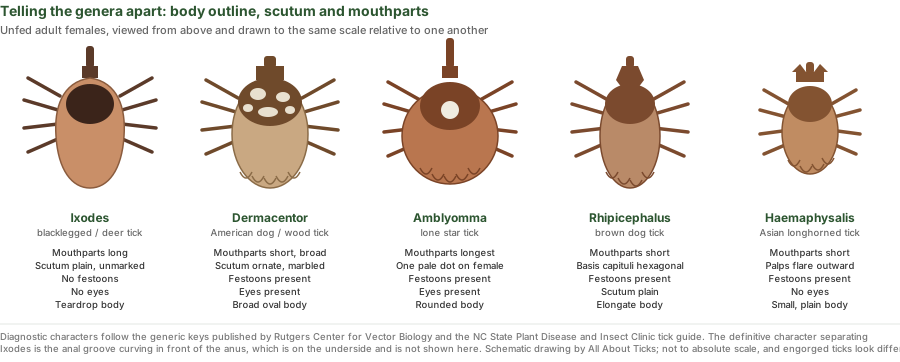
Two cautions before you use the chart. The character that definitively separates Ixodes from the rest is the anal groove curving in front of the anus rather than behind it, and that sits on the underside where a photograph of a tick on skin will never show it. And every one of these outlines describes an unfed adult female: once a tick has fed, the body swells into a grey or olive sac that obscures the scutum pattern entirely, which is why an engorged tick is genuinely hard to identify from a photo. If the tick bit someone, the species matters enough to be worth a free expert identification rather than a guess.
Blacklegged (deer) tick
Ixodes scapularis
Solid reddish-brown body with darker legs; no pattern. Unfed adult ~3 mm (sesame-seed); nymphs are poppy-seed tiny.
Where: Northeast, Midwest, upper Southeast US and eastern Canada.
Can carry: Lyme disease, anaplasmosis, babesiosis, Powassan virus.
CDC species & photosWestern blacklegged tick
Ixodes pacificus
Solid dark body, similar to its eastern cousin. Small; nymphs poppy-seed tiny.
Where: Pacific coast US and southern British Columbia.
Can carry: Lyme disease (lower infection rates than the East), anaplasmosis.
CDC species & photosAmerican dog tick
Dermacentor variabilis
Ornate brown body with whitish/silver marbling on the shield. Larger (~5 mm unfed). Often called a "wood tick."
Where: Widespread east of the Rockies, the Pacific coast, and into the Canadian Prairies.
Can carry: Rocky Mountain spotted fever, tularemia; can cause tick paralysis. Not a Lyme carrier.
CDC species & photosLone star tick
Amblyomma americanum
Round, reddish-brown; the female has a single white/silver dot in the centre of her back. Aggressive biter. (Males have faint pale streaks near the edge.)
Where: Southeast and eastern US, spreading north; common on Long Island and in the mid-Atlantic.
Can carry: Ehrlichiosis, STARI, tularemia; its bite is linked to alpha-gal (red-meat) allergy.
CDC species & photosRocky Mountain wood tick
Dermacentor andersoni
Ornate brown body with whitish marbling, very similar to the American dog tick. Larger (~5 mm unfed).
Where: Rocky Mountain states and interior British Columbia/Alberta, in shrubby and grassland areas.
Can carry: Rocky Mountain spotted fever, Colorado tick fever, tularemia; can cause tick paralysis.
CDC species & photosBrown dog tick
Rhipicephalus sanguineus
Solid, uniform reddish-brown with an elongated body. The only common tick that readily lives and breeds indoors (homes, kennels).
Where: Across the US, most impactful in the warm Southwest; worldwide.
Can carry: Rocky Mountain spotted fever (notably in the Southwest); a major concern for dogs.
CDC species & photosGulf Coast tick
Amblyomma maculatum
Ornate brown body with silvery markings; resembles the dog tick but favours coastal prairies.
Where: Gulf Coast and southeastern US, expanding inland.
Can carry: Rickettsia parkeri spotted fever (a milder spotted-fever illness).
CDC species & photosAsian longhorned tick
Haemaphysalis longicornis
Solid, small, plain reddish-brown with no clear markings. Invasive; can appear in huge numbers on a single animal.
Where: Eastern US since 2017 (first found in New Jersey), spreading.
Can carry: Mainly a livestock and pet threat in North America; its role in human disease here is still being studied.
CDC species & photosHow to be sure — and what to do next
This narrows the field, but the safest confirmation is an expert looking at a clear photo. These free or low-cost services identify ticks and, in some cases, test them for pathogens:
- Canada: eTick.ca — upload a photo, get an expert reply (usually within 24 hours).
- Pennsylvania: PA Tick Research Lab — free tick testing for PA residents.
- US (mail-in): TickReport (UMass Amherst) — identification and pathogen testing.
- Your area: many state and provincial health departments identify ticks — see our USA and Canada guides.
Remove it safely
Fine-tipped tweezers, steady upward pull, and mistakes to avoid.
Tick removal guideQuick tips
- Photograph the tick's back in good light before it feeds.
- A fed tick swells and darkens — markings can disappear.
- Only Ixodes (blacklegged) ticks spread Lyme in North America.
- Save the tick in a sealed bag in case testing is offered.
What this tool will not tell you
The filters above assume an unfed tick whose back you can see. Three situations break that assumption, and they are the usual sources of a wrong identification.
Engorgement hides the characters the chart uses. An unfed adult female has a small hard shield, the scutum, covering only the front of the back. As she feeds, the soft alloscutum behind that shield expands into a grey or olive sac. Ornate marbling on a dog tick, the single pale spot on a lone star, and the rear festoons can all vanish from a phone photo. Mouthparts still help: Ixodes and Amblyomma keep long palps, Dermacentor and Rhipicephalus keep short ones. That is often not enough. Photograph the tick's back in good light before you pull it if you can do so without delaying removal, then use eTick.ca or a state lab rather than matching a swollen tick to an unfed drawing.
Common mix-ups are predictable. People call almost every hard tick a wood tick. In the Midwest and the East that name is usually the American dog tick; in conversation it is also used for blacklegged ticks, which look nothing like a marbled Dermacentor. A lone star female is the only common eastern tick with one bright pale dot; an ornate shield with lots of pale scribble is a dog tick or a Rocky Mountain wood tick, not a lone star. Brown dog ticks live with dogs indoors and have a plain brown scutum plus a hexagonal base to the mouthparts. Blacklegged ticks have no festoons, long mouthparts and a dark plain scutum. Asian longhorned ticks are small, plain and can appear in large numbers on one animal; they lack the white dot and the marbled shield. If two cards in the grid still look possible, widen the markings filter to “Not sure” and send a photo.
A pathogen test is not a diagnosis. Labs such as the PA Tick Research Lab and TickReport report what the tick carried. They do not report whether that organism entered your blood. Transmission depends on species, how long the tick was attached, and which pathogen (Powassan can move faster than Borrelia burgdorferi). A negative result also does not rule out infection from a second tick you never found. Symptoms and a clinician still decide care. Save the tick in a sealed bag in the freezer if a local programme wants it; do not delay removal to hunt for a mailer.
Nymphs are the stage that causes most Lyme disease in the Northeast and Upper Midwest because they are poppy-seed small and easy to miss. The silhouettes in this tool are adults. If the tick is that small, treat it as a nymph of whichever species your state or province page lists as common, and get a photo ID if the bite was on a person.